Dry Fly Floatant Guide: Keep Your Flies Riding High

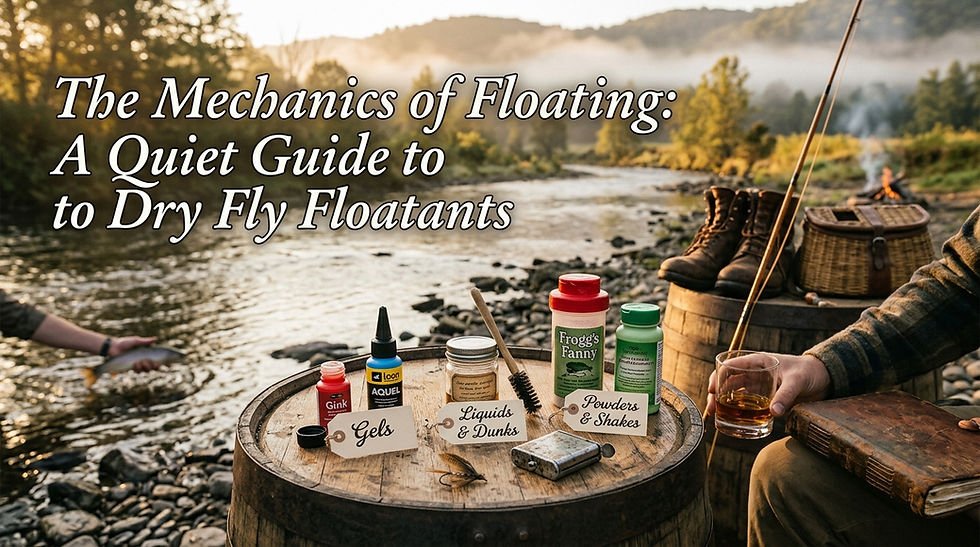
There is a specific kind of frustration that belongs solely to the dry fly angler. You’ve spotted a rising trout in the slow bend of the creek, right where the hemlocks cast a long shadow. You tie on a fresh Parachute Adams, your fingers a little stiff in the early morning chill. The first cast is a clean line, but by the time the fly reaches the seam, it’s riding low. By the third cast, it doesn't float at all. It drags beneath the surface like a drowned moth.
A wet dry fly is a broken promise.
To keep a hook, some steel, thread, and feather floating on top of a moving current requires a bit of physics and a little chemistry. Just as you wouldn’t seal a white oak workbench with the same finish you’d use on a delicate pine picture frame, you shouldn’t treat every dry fly with the same bottle of goop.
Here is a practical look at the jars, tubes, and bottles rattling around in your vest, and how to use them without making a mess of your morning.
---
The Gels: The Linseed Oil of the Stream
If you carry only one floatant, it is likely a tube of silicone gel. Brand names like Gink or Aquel have been tucked into the pockets of waxed-canvas vests for decades.
Gel is the blue-collar workhorse of the fly fishing world. It works by creating a hydrophobic barrier around the fibers of the fly, forcing water to bead up and roll off.
How to use it:
The common mistake is greed. If you use too much, your fly becomes a matted, greasy glob that looks less like a Mayfly and more like a drowned beetle. Put a drop the size of a pinhead on your index finger. Rub it between your thumb and finger until it warms up and thins out. Then, work it gently into the hackle and tail of the fly.
Best suited for:
Fly Types: Classic hackled flies like the Royal Wulff, Elk Hair Caddis, or any pattern with stiff rooster cape.
Water Types: Riffles, pocket water, and broken currents. The gel holds up well to the beating of rough water.
Avoid on: CDC (Cul de Canard) flies. Gel will ruin them instantly.
---
The Liquids and Dunks: The Shellac of the Fly Box
Liquids—often sold in wide-mouthed bottles as "fly dunks"—are solvents carrying a suspended water-repellent agent. You drop the entire fly, still tied to your leader, into the liquid, close the lid, and shake it. When you pull the fly out, the solvent quickly evaporates in the air, leaving a micro-thin, uniform coat of waterproofing over every single fiber.
It is a clean, satisfying process, much like dipping a cut of meat into a fondue bowl.
How to use it:
Drop the fly in, give it a five-second bath, blow on the fly to help the solvent evaporate, and then false-cast once or twice to clear the excess.
Best suited for:
Fly Types: Large, bushy flies like Stimulators, foam-bodied terrestrials (Chernobyl Ants), and hair-wing patterns. It is also excellent for pre-treating flies at your kitchen table the night before you hit the water.
Water Types: Medium to fast water. It provides a comprehensive coat that doesn't wash off easily.
---
The Powders and Shakes: The Dry Shampoo of the Creek
There are two kinds of powders in this world: brush-on powders (usually containing silica or hydrophobic dust) and desiccants (often called "shake-and-bake" style).
Desiccants are not actually floatants; they are drying agents. When a trout eats your fly, it coats the feathers in mucus and slime. The fly is waterlogged and ruined. You cannot put gel on a wet fly—it only seals the water inside the fibers, keeping it sunk. You must dry it first.
The shake-style container is filled with small crystals that thirstily suck every molecule of moisture out of the fly.
How to use it:
Drop your slimy, wet fly into the bottle of powder. Close the lid and shake it like a small can of spray paint. When you pull it out, the fly will be covered in a white dust. Blow the excess off, and the fly will look brand new, riding high and dry.
Best suited for:
Fly Types: Cul de Canard (CDC) flies. CDC is naturally buoyant because of the oils from the duck’s preen gland, but the feathers are incredibly delicate. If you touch them with gel, they mat down and lose their natural air-trapping ability. Powders keep CDC light, fluffy, and breathing.
Water Types: Glassy, slow pools where trout have all the time in the world to inspect your presentation. A greasy gel slick on flat water will spook a wild brown trout faster than a shadow. Powder leaves no oily sheen on the surface.
The Verdict: What Belongs in the Vest?
If you talk to three different anglers, you’ll get four different opinions on this. But if you appreciate simple utility, you don’t need a chemistry lab hanging off your chest.
Keep it to two items.
First, carry a small tube of silicone gel. It’s your standard oil for the daily grind. It stays on your vest on a zinger, easily reached when you want to grease up a Caddis before tossing it into a bubbling run.
Second, carry a small tub of desiccant powder. Think of it as your restoration kit. When a nice eleven-inch brook trout finally takes your fly and leaves it a soggy, crumpled mess, that powder is the only thing that will bring it back to life.
There is a quiet satisfaction in these small rituals. Sitting on a flat stone by the stream, letting the water run past your boots while you carefully dry and dress a fly, is part of the rhythm. It forces you to slow down. It demands patience.
And when you cast that fly back into the seam, and it rides high, light, and dry—exactly where the water meets the air—you’ll know the effort was worth it.
Now, go wash the silicone off your fingers before you pour yourself a glass of rye tonight. That’s a flavor you don't want to mix.


Comments